One Shift, One Checklist: A Plumber’s Routine for Clearing a Blocked Drain in Jaraguá
By the end of this page you will have a working checklist that takes a backed-up drain from “water rising in the shower” to “flow restored and documented” — the same sequence a field technician follows on a call-out in Jaraguá, in São Paulo’s North Zone. I am writing this as a practitioner walking you through my own routine, not as a sales pitch: the order of steps, the tools I reach for, the mistakes that turn a two-hour job into an all-night one, and the moments when you should stop and call a desentupidora Jaraguá team instead of improvising.
Search intent here is practical: you have a blockage, or you manage a building that keeps having them, and you want a repeatable method. So the article is built as a checklist you can follow while working — overview first, then the detail sections, then a closing action you can take today.
The checklist I run before, during and after every unblocking call
Every job starts the same way: I stand still for two minutes and gather information before touching a single tool. That pause is the difference between a clean unblocking and a flooded corridor. The checklist below is the skeleton; the sections after it explain why each item exists and what goes wrong when it is skipped.
Stage 1 — Before you touch anything
- Confirm the address and the type of property. A house in a residential street of Jaraguá behaves differently from a ground-floor shop or a condominium riser. Access, parking and the location of the inspection box all change the plan.
- Ask what backed up and when. A single slow shower drain is a local clog. A toilet gurgling when the kitchen sink runs points to a shared branch. Water coming back through a floor drain after rain is a different problem entirely.
- Ask what has already been tried. Chemical drain cleaner, a hand plunger, a borrowed manual snake — each one changes what I will find inside the pipe and how careful I need to be with the equipment.
- Locate the cleanouts and the inspection box. If nobody knows where they are, that is the first task, not the last.
- Protect the area. Old towels, plastic sheeting, and a bucket under the lowest opening. A blockage under pressure releases suddenly, and the mess is always worse than the client expects.
Stage 2 — During the unblocking
- Start at the lowest access point, not at the fixture that looks worst.
- Test flow before and after each pass. Run water, watch the level, listen for air movement.
- Escalate tools in order: plunger, manual auger, electric snake, then hydro-jetting only when the line is confirmed and the pipe material allows it.
- Record what comes out. Grease, roots, wipes, grit, or a collapsed section — the debris tells you whether this is a one-off or a recurring pattern.
Stage 3 — After the water runs clear
- Flush every fixture on the same branch, not just the one that was blocked.
- Check joints and cleanout caps for seepage.
- Write a short report with what was found, what was done, and what to watch.
- Recommend a follow-up only when the evidence supports it — a camera inspection for a repeat blockage, a preventive jetting schedule for a commercial kitchen, and so on.
That is the whole routine in miniature. The rest of this article explains the reasoning behind each stage, because a checklist you do not understand is just a list.
Why each step matters, and where technicians get it wrong
The biggest mistake in drain work is treating every blockage as the same blockage. In practice, a technician arriving at a property in Jaraguá is diagnosing three things at once: what is blocking the pipe, where in the network it sits, and whether the pipe itself is still sound. Skip the diagnosis and you end up clearing the same line twice in a month — or, worse, breaking something that was already fragile.
Reading the symptoms before you choose a tool
Slow drainage across several fixtures on the same floor usually means a branch line is partially blocked. A single fixture that backs up immediately points to a trap or a short section right behind it. Gurgling sounds and sewage smells in rooms far from the blockage suggest a venting problem or a main line issue, not a local clog. When water rises in a floor drain during heavy rain, the cause may be outside the building entirely — in which case no amount of snaking inside will fix it, and the right move is to document the event and escalate to the building manager or the utility.
I write these symptoms down before I open anything. It takes a minute, and it gives me a baseline to compare against once the water starts moving.
Tool selection: the escalation ladder
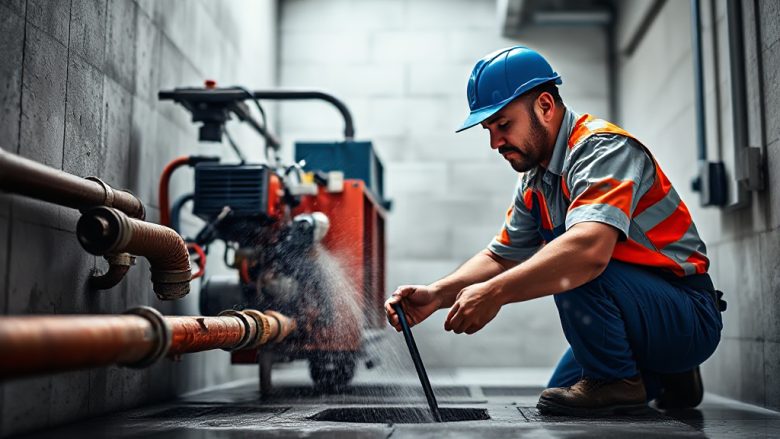
A plunger is not a joke tool. On a simple trap blockage, a proper plunger with a good seal clears the line in under a minute and disturbs nothing. A manual auger handles hair and soap buildup in a branch. An electric snake is for longer runs and tougher material, and it needs a careful hand: forcing it through a fitting can crack older PVC or dislodge a joint that was already failing.
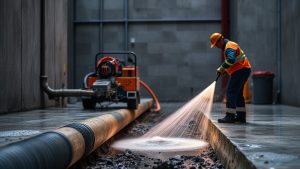
Hydro-jetting is the heavy option, and it is where inexperienced operators cause the most damage. High-pressure water is excellent for grease, scale and roots in a line that has been inspected and confirmed to be in reasonable condition. It is the wrong tool for a pipe you have not looked at, and it is the wrong tool for a line that is already collapsed. The professional sequence is inspect, confirm, then jet.
What the debris tells you
When the line clears, look at what came out. Grease and food residue mean the kitchen needs a grease trap routine, not just a one-time unblocking. Wet wipes and hygiene products mean the household needs a conversation about what goes in the toilet. Roots mean the pipe has a crack or a joint gap that will attract roots again. Grit and sand mean the line may be settling or has a low point that traps solids. Each of these leads to a different recommendation, and none of them are solved by clearing the blockage alone.
This is also where a good desentupidora Jaraguá São Paulo SP service distinguishes itself from a quick fix: the report matters as much as the unblocking, because it is what prevents the next call.
The mistakes I see most often
- Pouring chemical cleaner into a fully blocked line. It sits in the pipe, heats up, and can damage seals and older fittings without clearing anything.
- Snaking from the fixture instead of the cleanout. It works sometimes, but it pushes debris deeper and can scratch the inside of the trap.
- Ignoring the vent. A drain can be clear and still gurgle and smell if the venting is blocked.
- Declaring victory too early. Running one tap for ten seconds proves nothing. Flush every fixture on the branch and watch for a full minute.
- No documentation. In a condominium, a written record of what was found and when is what stops the same argument recurring at the next assembly.
When to stop and call a professional team
There are clear signals that the job has outgrown a DIY checklist. Sewage backing up into multiple fixtures at once, water rising in a floor drain during rain, a cleanout that will not open, repeated blockages in the same spot within a few weeks, or any sign of a collapsed or root-invaded line — these are all cases where the right next step is a camera inspection and a proper diagnosis. In an emergency, the practical move is to stop using water in the affected area, keep the area ventilated, and call a team that can attend at night or on a weekend rather than waiting for Monday.
For buildings and businesses in the North Zone, that usually means a desentupidora em Jaraguá São Paulo SP with 24-hour emergency attendance, because a blocked main line at 11 p.m. in a condominium is not something that can wait for a scheduled visit.
Prevention: the part of the routine nobody photographs
The most useful thing a technician can do on a call-out is leave the property less likely to call again. That means practical advice, not a lecture. A mesh strainer in every shower and sink. A grease container in the kitchen with a clear rule about what never goes down the drain. A monthly habit of running hot water through the kitchen line. A note in the building’s maintenance log about when the last jetting was done. And a simple rule for the whole household: if it is not water, toilet paper or human waste, it does not go in the toilet.
For commercial kitchens and condominiums, preventive hydro-jetting on a schedule is cheaper than emergency call-outs, and it keeps the line in a known condition instead of a mystery. The trade-off is planning: it requires someone to own the schedule and keep the records. In practice, the buildings that avoid emergencies are the ones where a single person is responsible for the maintenance log and actually updates it.
| Signal | Most likely cause | Right next step |
|---|---|---|
| One slow fixture | Local trap or branch clog | Plunger, then manual auger |
| Several fixtures backing up | Branch or main line blockage | Access via cleanout, electric snake, inspection |
| Gurgling and smell elsewhere | Vent or main line issue | Vent check and camera inspection |
| Backup during rain | External network or stormwater issue | Document and escalate; do not snake blindly |
| Repeat blockage in weeks | Roots, collapse or grease buildup | Camera inspection, then jetting or repair |
Your closing action: turn the checklist into a routine
If you take one thing from this page, take the sequence: gather information, protect the area, start at the lowest access point, escalate tools in order, flush every fixture, and write down what you found. That sequence is what turns a stressful blockage into a routine job, and it is what separates a technician who fixes the problem from one who just moves it.
For a household, the closing action is simple: print the Stage 1 questions and keep them near the maintenance folder, so that the next time a drain backs up you already know what to tell the technician. For a condominium manager or a business owner, the closing action is to put a name and a date against the last inspection and the next preventive jetting — because the buildings that never have emergencies are the ones where that date exists.
And if the checklist reaches a point where the diagnosis is unclear, the line is suspect, or the timing is simply impossible, the sensible move is to hand it to a team that does this every day. A blocked drain is a plumbing problem, but a recurring one is a maintenance problem, and the second kind is always cheaper to solve on a schedule than at midnight.
Frequently asked questions
How long does a typical unblocking take in Jaraguá?
A simple trap or branch blockage is usually cleared within an hour, including setup and testing. A main line that needs an electric snake or hydro-jetting can take two to three hours, and a line that requires camera inspection and a report may take longer. The variable is not the equipment; it is how quickly the access points can be located and how much debris has built up.
Can I use chemical drain cleaner before calling a technician?
It is better not to, especially on a fully blocked line. The chemical sits in the pipe without draining, can damage seals and older fittings, and makes the technician’s job more hazardous. Mechanical clearing is safer and more predictable, and it lets the technician see what the blockage was made of.
Why does my drain keep blocking in the same place?
A repeat blockage in the same spot almost always means the underlying cause was never addressed: roots entering a joint, a low point trapping solids, a partially collapsed section, or grease buildup from a kitchen without a proper trap. Clearing the pipe restores flow, but only an inspection identifies why it blocked, and that is what determines whether the fix is jetting, repair or a change in habits.
Do I need to be home for an emergency call-out?
Someone with access to the property and knowledge of the cleanout locations should be present. For condominiums, the building manager or the doorman usually handles access. If the blockage is in a common area, the technician may need to work from a shared inspection box, so it helps to have the building’s maintenance contact available.
What should I do while waiting for the team to arrive?
Stop using water in the affected area, keep the space ventilated, and move anything valuable away from floor drains. Do not keep plunging or pouring chemicals — both can make the situation worse. If sewage is backing up, avoid contact with the water and wash anything that touches it.