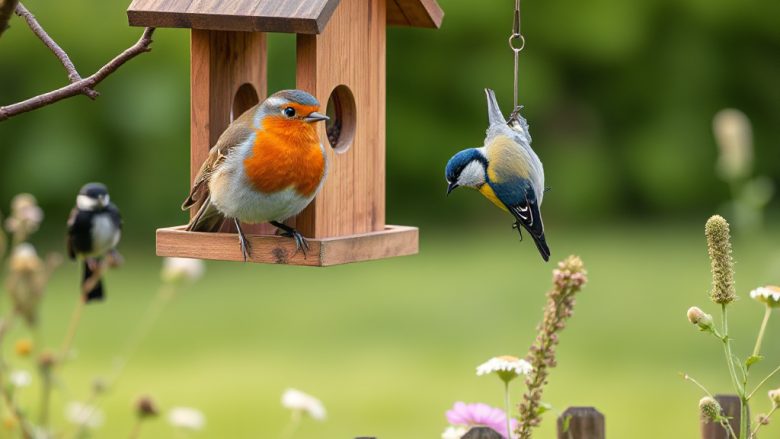
There’s a quiet pleasure in noticing the birds that share your outdoor space. A flash of yellow on the feeder, a neat brown shape hopping across the lawn, a sudden burst of song from the hedge. Once you start paying attention, the garden becomes a livelier place. The good news is that learning how to identify common birds in your garden doesn’t require a degree in ornithology. A few key features — size, colour, behaviour and song — will get you most of the way there.
This guide is written for the curious beginner. You don’t need expensive binoculars or a shelf of field guides. You just need to slow down, watch carefully, and build up a mental picture of the birds that visit you most often. By the end, you’ll be able to tell a blue tit from a great tit, a robin from a dunnock, and a blackbird from a starling without reaching for your phone.
Get Started with the Basics
Before you try to name anything, spend a week or two simply watching. Put a feeder out if you haven’t already, or leave a patch of lawn a little untidy. Birds are creatures of habit, and the same species tend to turn up at the same times and in the same places. Morning is usually busiest, especially in spring and early summer when adults are feeding young. A quiet half-hour with a cup of tea by the window can teach you more than any book.
When you’re ready to start identifying, focus on four things in this order: size, shape, colour and behaviour. Size is relative — compare the bird to something familiar. Is it about the size of a sparrow, a starling, or a blackbird? Shape matters too: a round, plump body suggests a finch or tit, while a sleek, streamlined body points to a thrush or starling. Colour is the most obvious clue, but be careful. Light changes everything. A bird that looks grey in the shade can look almost blue in full sun, and juveniles often have duller, streakier plumage than adults.
Behaviour is the secret weapon of the beginner. Two birds of similar size and colour can be told apart by how they move. Does it hop or walk? Does it cling to the feeder or feed from the ground? Does it flick its tail or bob its head? These little habits are consistent and reliable, even when the light is poor.
One more thing: don’t try to identify every bird at once. Pick one species a week and really learn it. You’ll retain far more that way, and you’ll start to notice the subtle differences between similar birds.
Compare Five Common Garden Birds
These five species turn up in gardens across the UK and much of Europe. They’re a great starting point because they’re distinctive once you know what to look for. The table below gives you a quick comparison, followed by a little more detail on each.
| Bird | Size | Colour | Behaviour | Song |
|---|---|---|---|---|
| Robin | Small, round | Brown back, orange-red breast | Bold, territorial, follows digging | Sweet, wistful, often winter song |
| Blue tit | Tiny, plump | Blue cap, yellow belly, white cheeks | Acrobatic, hangs upside down | High-pitched, rapid trill |
| Great tit | Small, larger than blue tit | Black head, white cheeks, yellow belly | Confident, often on feeders | Two-note, seesaw call |
| Blackbird | Medium, thrush-like | Males black with orange bill; females brown | Ground feeder, hops, flicks leaves | Rich, fluting, from a high perch |
| House sparrow | Small, stocky | Brown and grey, males with black bib | Sociable, noisy, feeds in groups | Simple chirps and cheeps |
The robin is often the first bird people learn to recognise, and for good reason. That orange-red breast is unmistakable, though young robins in summer lack it and look like a plain brown bird with a speckled chest. Robins are famously bold. They’ll perch on a spade handle while you dig, waiting for worms. Their song is a gentle, melancholy warble that you’ll hear at odd hours, even under streetlights in winter.
Blue tits are tiny bundles of energy. Look for the blue cap, white cheeks and lemon-yellow belly. They’re acrobats, often hanging upside down from a peanut feeder or a branch. Their call is a high, thin trill that can be easy to miss if your hearing isn’t what it was. Great tits are close relatives but noticeably bigger, with a black head and a broad black stripe down the belly. Their two-note song — often described as sounding like a squeaky pump — is one of the first sounds of spring.
Blackbirds are larger and more deliberate. The male is all black with a bright orange-yellow bill and eye-ring. The female is brown, often with a paler throat and a mottled chest. They feed on the ground, turning over leaves with a flick of the head. Their song is rich and fluting, delivered from a high perch at dusk. House sparrows are the sociable ones. They arrive in noisy groups, squabbling over crumbs. Males have a black bib and a grey crown; females are plain brown with a pale stripe behind the eye.
Use Behaviour and Song to Tell Similar Birds Apart
Two birds can look almost identical and still be easy to separate once you know how they behave. Take the dunnock and the house sparrow. Both are small, brown and streaky. But the dunnock is a shy, solitary bird that shuffles along the ground with a nervous, creeping gait. It rarely visits feeders and prefers the cover of a hedge. The house sparrow is brash and communal, usually in a group, and will happily crowd onto a bird table.
Song is another powerful clue, though it takes practice. Start by learning just a handful of calls. The robin’s winter song is a series of thin, silvery notes that rise and fall. The great tit’s spring song is a clear, repeated two-note phrase. The blackbird’s is a slow, rich melody with pauses, often sung from a rooftop or treetop. The blue tit’s is a rapid, high-pitched trill. And the house sparrow’s is less a song than a chorus of chirps and cheeps.
Don’t worry if you can’t identify a bird by song alone at first. Use it as a supporting clue. If you hear a two-note call and then see a yellow-bellied bird with a black head on the feeder, you can be confident it’s a great tit. If you hear a fluting song at dusk and spot a black bird with an orange bill on the lawn, that’s your blackbird.
Behaviour around feeders is especially useful. Blue tits and great tits will cling and swing. Robins prefer a perch and will often take a seed and fly off to eat it. Blackbirds and dunnocks feed on the ground beneath the feeder, cleaning up what falls. Starlings, if you get them, arrive in a noisy crowd and demolish everything in minutes.
Keep a Simple Log to Build Your Skills
You don’t need a fancy app or a notebook with columns. A simple list on your phone or a scrap of paper by the window is enough. Each time you see a bird you recognise, jot down the date, the time, the weather and what it was doing. Over a few weeks, patterns will emerge. You’ll notice that the blue tits arrive first thing in the morning, the blackbirds come at dusk, and the sparrows turn up in a noisy gang after rain.
If you see a bird you can’t identify, write down what you noticed: size, colours, where it was, what it was doing. Even a rough sketch helps. Then look it up later. The act of writing it down forces you to pay attention to details you might otherwise miss.
Over time, your log becomes a personal record of your garden’s wildlife. You’ll start to recognise individual birds — the robin with a slightly paler breast, the blackbird with a white feather on its head. That’s when identification stops being a chore and becomes a genuine pleasure. You’re no longer just looking at birds; you’re getting to know them.
Frequently Asked Questions
What’s the easiest bird to identify in a garden?
The robin is usually the easiest. That orange-red breast is hard to mistake, and robins are bold enough to let you get a good look. Just remember that young robins in summer are brown and speckled, without the red breast.
Do I need binoculars to identify garden birds?
No. Most garden birds are close enough to see with the naked eye, especially if you have a feeder near a window. Binoculars help for birds in distant trees, but they’re not essential when you’re starting out.
Why do I see different birds at different times of year?
Some birds visit gardens mainly in winter, while others are more visible in spring and summer when they’re nesting and feeding young. Weather also plays a part. Cold snaps bring more birds to feeders, and mild winters can change which species turn up. Keeping a simple log will help you spot these seasonal patterns.